Wednesday, April 13, 2011

When Coyness is a Crime


            Andrew Marvell’s “To His Coy Mistress” is a witty and persuasive poem intended to seduce the speaker’s mistress into abandoning her coyness and engaging in physical pleasure. Several features mark Marvell’s poem as unique—his unconventional imagery and comparisons, his defined structure that correlates with his strong logical argument, his raunchy tone, and his wordplay. Through such techniques Marvell beautifully expresses his struggle between the desires of flesh and soul.            
            The basic structure of the poem lays out the speaker’s transitioning appeal to his mistress. The first verse follows the ideals of courtly love: years and years of eager adoration and a sweet love that grows slowly. Marvell presents a romantic image of two lovers strolling through a garden and then the man pining for his love at the opposite end of the world by the Indian Ganges. She could refuse him till eternity, or as Marvell unconventionally states, “till the conversion of the Jews” (to Christianity). The speaker is overflowing with emotion, dedicating “an age” of praise “at least to every part” of her body. But his argument quickly shifts with the next stanza, which points out that time could never allow such indulgence but will destroy their youth and possibly their love. The speaker questions what motives the lady has for postponing her desire, for “The grave’s a fine and private place / But none, I think, do there embrace.” However, as Marvell explains in the last verse, a lonely death in a “marble vault” can be avoided if only the lady would submit to carnal desire. He knows her soul is “willing” and “transpires at every pore with instant fires,” so instead of allowing time to rob their youth and fun, the couple should take control over their time together and “at once [their] time devour.” He proposes an impassioned sexual union full of “pleasures with rough strife” that would make time run just to catch up with them.
            While much can be said about the persuasive qualities of Marvell’s logical structure, what truly promotes his argument are his unique imagery and clever diction. In place of typical petrarchan descriptions known for their hyperbolic declarations of love, Marvell employs unconventional metaphors and allusions to describe his emotions. He likens his love to the slow growth of a vegetable instead of the more typical blossoming of a flower. His allusions to Noah and then to the Last Judgment as comparisons of how long his love would last are also unusual for love lyrics. The haunting images of “deserts of vast eternity,” an echoing “marble vault” as a coffin are foreboding thoughts that might scare his mistress into submission. Perhaps even more commanding are Marvell’s images of desire and forceful love making. A soul transpiring “at every pore with instant fires” is certainly an arresting description of lust. Paired with the portrayal of “amorous birds of prey” that tear through “the iron gates of life,” there is a sense that the speaker is barely capable of restraining his own desire.
            This feeling is further supported by the noticeable presence of sexual innuendo via word play and grammatical structure. The first most noticeable aspect of the poem is its consistent rhyme scheme of AA BB CC and so on. These couplets emphasize the number two and perhaps represent a constant union. The grammatical structure also serves to represent the sexuality of the subject. The first verse contains lots of enjambment and punctuation in the middle of lines that work together to slow down the poem’s pace and rhythm. The second verse picks up pace with less punctuation, but things really speed up in the last stanza. Punctuation is reserved to the end of lines, and the sentences become shorter and more hurried in tone as the poem reaches its climax. The repetition of “Now” adds to the sense of urgency. If the sexual innuendo were not obvious enough, Marvell’s play on words and images like “worms shall try that long-preserved virginity,” the “iron gates of life,” and “quaint” a pun on queynte, are all graphic references to female genitals.            
            Although the sexual undertones may seem a bit crude, they certainly add interest and more sex appeal to the speaker, who is evidently battling to overcome his lust for the ideal of sweet, innocent love. This intense sexuality coupled with the unusual imagery and logical presentation all work together to form a very persuasive appeal to the “coy mistress”. After hearing such a passionate argument as this, I can’t imagine she could refuse much longer.

Sunday, March 13, 2011

Waiting for Enlightenment?


            The magistrate learns that being the only person to oppose something isn’t enough to incite real change. Without a large enough support group, one man’s opposition simply will not get you anywhere, except frustrated and miserable. The psychological  burden of actively acknowledging and feeling cruelty is too much for one person to handle on their own. The magistrate learns on several occasions that his lone protest gets him nowhere, except humiliated and thrown in jail.  Instead of winning glory he loses his dignity and torments himself psychologically with his own thoughts. “For now what I hear when I loosen my tongue and let it sail free is the subtle whining of a beggar,” he notes (149 Ink Edition). He is more like a begging loser than a righteous leader. The novel’s last sentence leaves the reader with the sense that the magistrate’s whole journey was perhaps pointless—for all the trouble he went through, nothing has come of it. He ponders, “Like much else nowadays I leave it feeling stupid, like a man who lost his way long ago but presses on along a road that may lead nowhere” (180).
            The magistrate’s captivation with the barbarian girl teaches him that people can lose their humanity, but that it is futile to spend time and thought insisting on its existence in such people. In taking the beaten barbarian girl in, the magistrate felt a sort of duty to find and restore her emotions, her character, and her humanity. But he soon learned that she was in some sort of a frozen state—nothing seemed to move, please, or hurt her. She “believ[ed] in nothing” (94). Only after he returns her to her people does the magistrate understand that after her torture, “she was no longer fully human, sister to all of us. Certain sympathies died, certain movements of the heart became no longer possible to her” (94). His “guardianship” of her was an attempt to restore her to something that was no longer possible. After some experiences, a sense of humanity and purpose simply cannot be recovered. (337)

Monday, March 7, 2011

Zealotry in Zimbabwe

Zimbabwe has long been known for its violent past and present. Under current president Robert Mugabe (who has been ruling for over three decades), vicious land redistribution has forced people off their property, sky-high inflation destroyed the economy, and rigged elections keep people in a state of fear and ensure Mugabe's power over a powerless population. During "elections" in 2008, the secret police or Joint Operations Command (JOC) orchestrated political violence that rocked the country, with hundreds killed  and thousands more beaten, tortured, wrongfully arrested and forced from their homes. "This country is now effectively run by a military junta," opposition leader Tsvangirai told reporters in Harare.

The opposition said its supporters were being systematically targeted


Sunday, February 13, 2011

Mr. Darcy Regrets: commentaries on the BBC film


  • The two texts take a better look into Darcy’s character, evaluating his feelings and how to translate them on screen. There isn’t really a thesis, except for maybe that despite his lack of emotion to the outside world, Darcy is really undergoing an emotional hurricane inside and that it takes all of his awkward behavior just to restrain himself.
  • Colin Firth talks about his search to discover Darcy’s inner state of mind in order to understand how to act like Darcy would have. He commented that he actually ended up emotionally defending him in several situations. For example, he says that when approaching the proposal scene, he had to get completely in Darcy’s head. He knew that he couldn’t play it as if he knew he were being shocking and arrogant, but instead make his condescending speech the most reasonable thing to say. Colin Firth says he imagined Darcy to be saying that, despite all the family rage their engagement would cause, the judgments he would receive, his love for Elizabeth is so overwhelming that these objections are rendered insignificant.  And from this point of view, it’s terribly romantic. Colin says, “I was a bit hurt when we filmed it, and everybody thought I was saying something terrible: I had got myself so far into the notion that he had come in with a really charming thing to say.”
  • I also really like Colin’s analysis of how and why Darcy fell in love with Elizabeth. Colin explains that Darcy is very bored, citing a quote that helped him understand his character’s behavior a lot—“A man who is eligible needs to entertain no one.” He never needs to respond or put himself forward. So Elizabeth’s attraction is that she gives him a chance to respond. As Colin says, she’s “probably the first opportunity he’s ever had in his life to be the pursuer rather than the pursued: it’s irresistible.” And that’s why Elizabeth’s eyes become so marking a physical feature. I think that Colin sums up Darcy’s lasting fascination with her from a man’s perspective when he says, “What starts off as intriguing becomes profoundly erotic for him.”
  • I completely agree with everything Colin says in this interview about Darcy’s character. To me, his behavior makes perfect sense and is actually quite endearing.
  • The second article also examines Darcy’s inner turmoil, but takes a different angle by examining the emphasis the film places on his physical expressions. In the film Darcy is seen swimming, riding, playing billiards, bathing, fencing, and giving doting stares. This physical activity is a way to show the depth of Darcy’s bodily struggle with his emotions. When engaging in physical activity, Darcy can be himself, but in society he can’t express himself to the same degree. The longing stares Colin gives are a representation of his struggle to express his desires.
  • Cheryl Nixon examines this theory in an analysis of the proposal scene. She says, “In the film adaptation, Elizabeth’s rejection…can be read as a rejection due to his inability to voice his full emotions. Compared with his doting stares, billiard playing, bathing, fencing, and swimming, Darcy’s proposal seems restrained; although he expresses his love, his is unable to put his hidden emotions into a verbal vocabulary that matches the intensity of his physical vocabulary.”
  • I wholly agree with Nixon’s perspective on the depth of Darcy’s physical expression of his emotions. Thinking about it more, I realized that those scenes where Darcy engages in physical activity actually do add to the sexual tension the book lacked. While the film’s depiction is a more modern take on his behavior, I can still imagine Darcy acting exactly so. It just aligns so well with his awkward habit of pacing back and forth or just simply not talking to Elizabeth when walking alone with her or calling upon her. He has to release his emotional tension somehow.
  • I also had never thought of their relationship as being erotic, certainly Jane Austen would not say so, but the underlying tension and flirtation does actually create that effect. With Colin’s description of Darcy’s erotic perusal paired with his physical portrayal of Darcy, Pride and Prejudice suddenly seems a lot more sexy.  

Monday, December 6, 2010

If Theater Be the Food of Life, Play On!


            As a theater buff, I can safely say that the Southwest Shakespeare Company’s production of Twelfth Night was really quite good and definitely the most enjoyable Shakespeare I’ve seen. I was surprised by the intimacy of the setting. The other Shakepseare performances I’ve attended were staged in large theaters, so I really liked the small theater-in-the-round in Mesa. It was great to be so close to the actors and see their expressions so clearly. I also enjoyed being on such familiar terms with the text. I knew what jokes were coming and had a fun time comparing and contrasting the performance to what I had always imagined took place. Besides the reality that Alex Kost is actually Viola dressed as Cesario (the similarity is creepy!) , I picked up on some notable differences and interpretations of the text.
            First of all, I would like to say that I think the actor who played Sir Toby did a fabulous job. He really added a whole new dimension of comedy to the play. In my head I had never imagined him to be so boisterous and enthusiastic but instead rather annoying and conniving. This Toby was both rambunctious and mischievous, always pushing the limits of decency with his drunken walk, song, and dance and loud voice. I also noticed that the director did a good job of developing the romance between Sir Toby and Maria. There were moments while reading the play that I thought the two would make a good couple, but their marriage still came as a bit of a shock to me. However, in this production the body language—they kissed once and hugged several times—between the couple made a lot of sense to me. I had wondered where exactly Toby was getting his ideas that Maria “adored him” when all they appeared to be doing was collaborating.
            Second, for me the live drama added more comedy to Orsino’s character, whose over-the-top manner made me laugh out loud on several occasions. The actor did a wonderful job playing up Orsino’s some might say “drama queen” personality, placing extra emphasis on his tone of voice and confident body language. I loved how he was always being rolled in and out on a chaise longue or bathtub. It really added to the dramatic effect of his character. As with Sir Toby and Maria, Orsino and Viola had a lot more on-stage chemistry than I had personally envisioned. I especially liked the scene when the two were playing cards and viola insists that women love as much or more than men. While reading the scene, I did not picture the aura between the two to be so flirtatious and full of subtlety. The stage directing was brilliant. There was so much tension in the scene, particularly when Orsino and Viola were so close they could almost kiss each other.
            Finally, the most obvious difference—the actual setting of the play—I was not so fond of. The fact that no mention was made of Russia and the costumes and music were only partly Russian in influence, although the setting was supposed to be Siberia, made me a bit confused. In general, I have to say that I am not a huge fan of re-setting Shakespeare in different time periods and locations. I understand the logic behind it—that Shakespeare is timeless and is rather a commentary on human nature and relations than on historical events or time periods—but I feel that it is unnecessary and can detract from the charm. Call me a traditionalist, but I like the Shakespearian garb and renaissance sets! Maybe, it’s just that I have yet to see a re-setting done well. Nonetheless, in all I had a wonderful time and thoroughly enjoyed spending my Sunday afternoon watching Twelfth Night. (630)

Monday, November 15, 2010

Is it All an Illusion?


            Illusion, the very word seems to be alluding its own meaning. In my initial research, I’ve come to find that the word is an illusion itself, meaning more than I thought it originally did. It may seem odd, but I like the sly personality of the word. An illusion can be anything we want it to be, so long as it deceives the eye or mind in some way. Everything and anything can be an illusion—are humans illusions of themselves? Is life an illusion? Or perhaps it might be better to ask: what isn’t an illusion? While pondering these deep questions, I’ve had some time to do a bit of research on the etymology, definitions, and use of the word illusion.
            The word in its present form is old French from the mid fourteenth century, but its roots (as those of most French words) are Latin. The Latin definition is a mocking, jesting, or irony and the Latin verb illudere translates as to mock. Thus, the original old French meaning was a mocking or act of deception. This correlates with the first definition listed in the Oxford English Dictionary (OED), the action of deriding or mocking. Furthermore, the word has always held the connotation of deception and trickery. One of the word’s first uses is in Richard Rolle of Hampole’s prose, where “illusyone of de enemy” is mentioned. Interestingly, illusions often seem to be associated with the devil. In Shakespeare’s Henry VIII the surveyor speaks of the “devil’s illusions”. This relationship with the devil connects illusion with magic. Illusion developed to mean an apparition or ghost and is often mentioned in the context of magic. In Hamlet Horatio cries, “Stay illusion!” to the ghost of the late king of Denmark. However it seems that illusion did not develop one of its more modern meaning of an “apparent perception of an external object when no such object is present” until the 1770s (OED). There appears to have been a kind of resurgence in the popularity of illusions. Houdini, the great illusionist, captured the world with his unworldly magic acts while Freud and other psychoanalysis emphasized the illusion of the subconscious. All of a sudden illusion became pop culture, further evident in the trendy Op Art of the 50s and 60s. I’d like to investigate how “the art of illusion” had its own renaissance in the fields of psychoanalysis, art, and magic in the 1900s.
            So far its been interesting to note where the word illusion has not come up. There is no trace of the word in the bible, as it is too young for such an old text. It does not once come up in Any of Lewis Carroll’s works, which was quite surprising to me considering the hallucinogenic descriptions of Wonderland. There isn’t a trace of it in Jane Austen’s writing or several other Victorian authors. It seems odd to me that illusion was such a rarely used word. I believe that its use must have greatly increased thanks to its famous proponents from a variety of spheres in the twentieth century. (513)

Tuesday, October 19, 2010

The Ellesmere Chaucer (Blog #6)


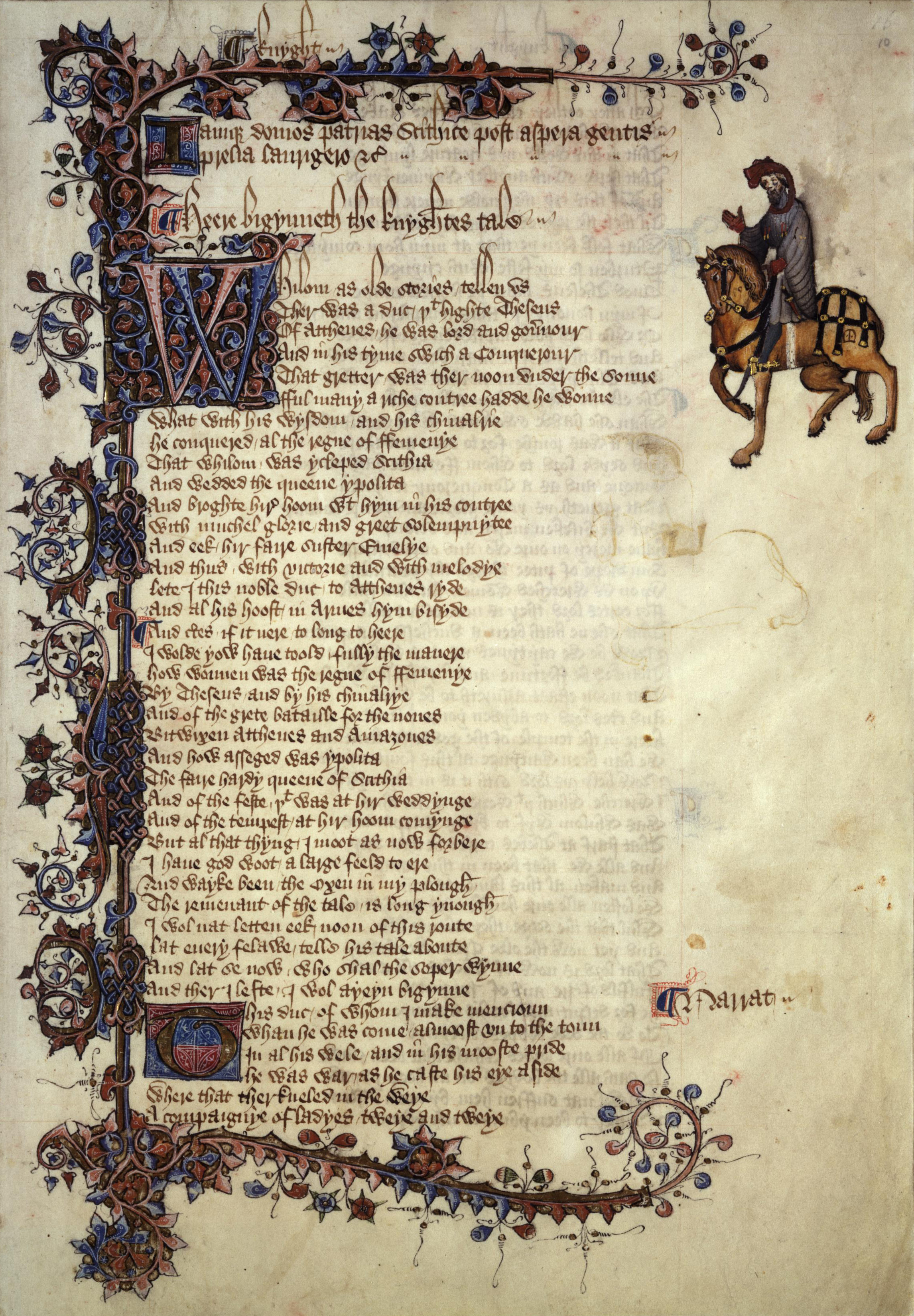
            Among the first manuscripts of The Canterbury Tales, the Ellesmere manuscript, also known as the Ellesmere Chaucer, holds an important place in literary and art history. The work is remembered today for both its textual and visual authority: it remains one of the best orderings of the tales and an epitome of medieval illuminated manuscripts.
            The significance of the Ellesmere Chaucer might best be understood with a description of how the Canterbury Tales have come down to us nearly six centuries later. The tales were always a work in progress for Chaucer. He wrote them in no particular order and left many unfinished. Moreover, unlike the unique Beowulf manuscript of which there is only one, over eighty different manuscripts, including fragments, have been identified. The problem deepens as none of these can be certainly dated in Chaucer's own lifetime, nor traced to a scribe directly employed or supervised by him. This means that nearly all the surviving manuscripts were written between 1400 and the time of Caxton's printing press less than a century later at which point the expense and tedium of hand-copying no longer seemed worthwhile. The Ellesmere manuscript is thought to have been written shortly following Chaucer’s death and possibly by the scribe Adam Pinkhurst, a man employed by Chaucer himself. The manuscript is therefore noted as a critical source for efforts to reconstruct Chaucer's original text and intentions. As Pinkhurst was acquainted with Chaucer, he might have had a better insight into Chaucer’s intentions for the Tales. Other arrangements of the stories have been tried, but the “Ellesmere order” (with a couple of changes) still serves to this day as the basic arrangement.
            The book itself remains of great worth not only for its textual contribution but also for its outstanding workmanship. Fortunately, the original Ellesmere manuscript survives to this day largely undamaged, due to the fact that it has rested in libraries since around 1600. The manuscript is beautifully bound and printed on 232 pages of the finest quality thin vellum, sound and flexible. The page dimensions are noteworthy, nearly 16 x 11 inches. However, the main glory of the manuscript is the lavish illumination and illustration, in which the Ellesmere is easily unrivaled. On no less than seventy-one pages large foliated initials are joined to "demi-vinet" borders (conventionalized vines), in gold and other colors, framing the text on three sides. Opposite the first line of each tale is the figure of that tale’s narrator. There are twenty-three highly individualized portraits, including a very famous one of Chaucer himself. The miniatures are of great charm and interest and all show a perfect understanding of the text they are intended to illustrate, unusual for medieval illustrations. Studies of illumination indicate that the manuscript was probably the work of three to four craftsmen and, interestingly, not of monks. The evidence suggests that the text, border, and figures were all done at the same time, also unusual for medieval manuscripts.  

The first page of the knight's tale. The demi-vinet and the knight's miniature are both visible.
            Thus the significance of the Ellesmere Chaucer is impressive: it is one of the two or three earliest manuscripts, one of the best authorities for the order of the tales, and one of the most splendid examples of medieval bookmaking. The Ellesmere Chaucer is easily the finest manuscript of The Canterbury Tales and is in every respect worthy of Chaucer himself.
A portrait of Chaucer.

Sunday, October 17, 2010

The Man of Law


          Chaucer presents the “Sergeant of the Lawe” exactly as a man of law: he strictly follows regulations and does nothing against the law. He owns his land without legal impediments and assures that all his purchasing “might not been infect” (322). Apparently, “every statut coude he plein by rote” (329) or, in other words, he could recite every statue by heart. He had memorized all of the laws, court cases, and decisions in England over the last 300 years and could therefore, Chaucer contends, write the most perfect legal document. Chaucer here is poking fun at the notion that memorization is akin to knowledge. The judge is wise and great, not because he is a great thinker or moralist, but because he can recite a law on demand.
            Despite his legal fastidiousness, the lawyer also has a bit of a more indulgent streak in him. He has grown rich lately, buying many nice robes and pursuing the path of a wealthy and powerful landowner.  He seems to enjoy this newfound reputation, meeting often in the prestigious porch of St. Paul’s Cathedral with his clients. He obviously takes pleasure in creating a persona about him to maintain his stature. As Chaucer writes: “Nowher so bisy a man as he her nas; / And yit he seemed bisier than he was” (324-5). The lawyer plainly likes to give off the impression of being wanted and valued by others for his work, however false this reputation may be. 
            Although it’s hard to tell, Chaucer was probably satirizing both the judicial system and the justice in this short snapshot. Chaucer mocks the so-called wisdom of the judge who really only memorizes court cases and decisions rather than thinking for himself. Perhaps Chaucer also hoped to express some appreciation for the emerging middle class. Most likely between the aristocratic and the middle class, the lawyer was a character who could travel across boundaries and expeirience the glamour of the wealthy and the streets of London. The lawyer does not fit into the traditional three estates and must therefore secure his high-ranking status through hard work, bragging, and in general being a bit of a poser. (361)

Sunday, September 19, 2010

Heorot Restored to Former Glory, Feasting and Celebration Abound!

The Mead Hall at Heorot,

          Alas, we are freed of the constant terror of the beast Grendel! The valiant and brave warrior Beowulf  (whose arrival we reported earlier) has murdered the evil kinsman of Cain. Grendel’s arm remains hanging from Heorot’s wall as a trophy of that great battle. Many a warrior attempted to rid Heorot of its pest, but for twelve long winters our once magnificent mead hall remained haunted. Only Beowulf has succeeded in destroying the monster, and for his courageous deed we are forever grateful.
            The victory feast was a great affair, and brought many back to the days when feasting and celebration were common in Heorot. The great hall was restored to much of its former glory (though Hrothgar has reported that he will be conducting some internal renovations promptly to update the decoration and replace destroyed parts), with banners, tapestries, and streamers aligning the walls and roof. The center of attention was upon our heroic savior, Beowulf. All praised and congratulated him. His fame and renown is already traveling far: horsemen departed Heorot early this morning to begin spreading Beowulf’s glory. Soon all men will know of his great strength, courage, and generosity. The celebration was soon underway in the majestic hall. A bard recounted Beowulf’s battle and even compared him to the noble dragon-slayer, Sigemund. It is important to note that throughout the festivities and the praising of Beowulf, no one forgot about our great King Hrothgar or denied his eminence as our ruler.
            Perhaps the most moving moment of the festivities was Hrothgar’s figurative adoption of Beowulf. Sitting between the two princes, Hrethic and Hrothmund, Beowulf graciously accepted Hrothgar’s affection and spoke of his respect for the king and his wonderful mead hall. As must be done to reward an honored warrior, treasures were bestowed in abundance. From the Danish treasury, Hrothgar presented Beowulf with a gold-wove banner, a broidered battle-flag, breastplate and helmet, a spending sword, and a few decorated steeds. Our great warrior accepted such illustrious gifts with alacrity. Hrothgar also made sure to pay the death-price for the Geatish warrior Grendel killed. Then, to continue the cheer and merry mead drinking, Hrothgar’s singer filled the hall with the saga of Finn, recounting that sad story of broken peace between us Danes and the Frisians. We shall never forget the plight of Hildeburh, but still wish the best for Freawuru and her betrothed, Ingeld the Heatho-Brad.
            To conclude the evening of merriment, our wise and lovely queen Wealhtheow made her presence known in a moving speech. She spoke confidently of her trust in Hrothful in guiding her sons and the kingdom when Hrothgar (praised be his heroic name) perishes. She addressed Beowulf with utmost respect and asked him too to be a mentor and friend of her sons. Expressing her great thanks to the strong warrior, the queen presented Beowulf with a rare and beautiful torque of gold and a suit of mail armor. And thus, the feast continued into the wee hours of the morning, with much mead drinking and celebration. Heorot is restored to glory, but one can’t help thinking that the struggle is not completely over yet. (525)
Reporting done by Hreporter for the Hrothgar's Heroic Herald

Sunday, September 12, 2010

Beowulf Passage Analysis

Page 63, lines 1518-1536

This passage portrays Beowulf struggling in the midst of battle with Grendel’s mother in the depths of the lake when he realizes that his sword is not strong enough to defeat the beast. Besides this moment of revelation, this selection is of significance for its vivid use of words and senses, both visually and orally. The aspect that struck me at first are the paired sets of words that seem to match each other so well in sound. Beowulf “heaved his war-sword and swung his arm” so that “the decorated blade came down ringing and singing on her head” (63). The combination of heaved and swung, especially with the similar-sounding sword, produces a nice set of sounds when said aloud and seem to fit the picture very well. The following set of ringing and singing, with their rhyme and strong sensory appeal (visually and audibly), only accentuate the first pair. The last duo in line 1530, fame and name, likewise fit together well in sound and meaning to enhance the second paragraph.

Also of note in the passage is the verb choice. I particularly like the use of the verb bite instead of cut when referring to the sword. The narrator says, “the shining blade refused to bite” (63). Bite is quite unusual, but strangely suitable in this case and does conjure a stronger image. The use of the verb hew is also interesting, it being somewhat of an onomatopoeia. The hard-sounding verb flung is also well placed in its context—the word fury is just before—and this small alliteration adds more emphasis to the “f” sound. The combination of the hard sounds, unusual verbs, and onomatopoeias add another dimension of appeal to this selection.

In addition to striking word choice and combination, the change in tone and perspective in the passage are also interesting. At first the tone is a bit depressed as Beowulf continues to struggle against the monster and his sword doesn’t work. The narrator says, “Here at last / the fabulous powers of that heirloom failed” (63). Then the tone lightens up as Beowulf regains confidence in his own strength. Furiously flinging his sword away, he decides (in a very dramatic, but inspiring move) to “rely / on the might of his arm” (64). The final shift in tone occurs in the next two sentences. Here the perspective changes from Beowulf’s to what comes off as the narrator in a direct address to the audience. It is written: “So must a man do / who intends to gain enduring glory / in combat. Life doesn’t cost him a thought” (64). These sentences have an instructional and almost preacher like tone about them, as if the narrator wants to inform his audience that a great warrior must only rely on his own strength to gain glory and that life shouldn’t be on the mind at a time like this. After all, it is all in a day’s work to be fighting a vicious monster underwater in a lake. I personally always enjoy little interjections like these from the narrator. They kind of ground the story back to reality in an unintentionally comical way, at least in my opinion. Overall, I thought this passage was engaging for its imagery, unique word choice, and somewhat silly narration. (545)

Wednesday, August 25, 2010

Inspired & Inspiring Reads

1. His Dark Materials, Philip Pullman (includes The Northern Lights, The Subtle Knife, and The Amber Spy Glass). I read these books a couple years ago and have loved them ever since. Though generally classified as young teen literature, the trilogy has some really deep thoughts and symbolism regarding the loss of innocence and the gaining of knowledge, organized religion, and humanity. It really shouldn't be put in the young adult section at Borders.

2. Eugene Onegin, Alexander Pushkin. As an introduction to Russian literature I couldn't have asked for anything better or more thoroughly enjoyable. I really enjoyed Pushkin's witty and often harsh sense of humor, especially regarding the melodramatic poet Lenski.

3. Harry Potter, J. K. Rowling. As my introduction to reading and ,you could say my first literary love, the Harry Potter series will always hold a place in my heart. Harry Potter is more than just a couple of books, it's a culture. When you grow up attending midnight book releases and making your own versions of the movies with friends, how could it be anything else?

4. Outlander, Diana Gabaldon. I love historical fiction as a literary genre and this series is a perfect example of great historical fiction. The books are so well researched that I'm always surprised by how much I've learned from reading them. Though I must admit that Diana Gabaldon has set my standards for men rather high with Jamie.

5. Murder on the Orient Express, Agatha Christie. My first Agatha Christie book and introduction to serious mystery, that is, beyond Nancy Drew. For some people the long interviews of suspects and always seemingly insane conclusions that nobody could ever guess are frustrating, but for me it all adds to the allure and intrigue of each book. I don't know who could top Poirot in detective flair and charm.

6. Daisy Miller, Henry James. A small novel, or novelette, with big ideas. I had a good time exploring Daisy Miller's innocence or lack thereof and James' fascination with life opportunities lost to society's decisive judgments.

7. Dead Souls, Nikolai Gogol. Another Russian with a wicked literary voice and sense of humor. Besides maybe J.D. Salinger I can't think of an author with a stronger narrative voice than Gogol. I would even say that Gogol might top his mentor Pushkin in this department. There were times that I laughed out loud while reading this.

8. SuperFreakonomics, Steven Levitt and Stephen Dubner. Some of the statistics and facts presented are completely mind boggling. The chapter on global warming entitled "What do Al Gore and Mount Pinatubo have in common?" opened my mind to an entirely different viewpoint of the problem and the best immediate solutions.

9. Angus, Thongs, and Full-frontal Snogging, and the 9 following books all by Louise Rennison. These are my guilty pleasure books. They may be complete trash in terms of literature but they are the funniest things I have ever read. From the main character's, Georgia's, hysterical antics to her hilarious vocabulary (there is a glossary) these books never fail to calm me down or make me laugh.

10. All Creatures Great and Small, James Herriot. Although I did not initially think of it, All Creatures Great and Small was one of my favorite reads as a tween. It reminds me of all the things I love about Britain and brings up memories of my own childhood in the English countryside. As in Herriot's books, it really isn't uncommon to go and see the annual lambing (lambs giving birth in spring).

Monday, August 23, 2010

Playing With Fire


Summer Reading:
Persuasion, Jane Austen
The Screwtape Letters, C.S. Lewis
            The Girl with the Dragon Tattoo,
            The Girl who Played with Fire,                 All Stieg Larsson
            The Girl who kicked the Hornet’s Nest (I’m about of 1/3 the way through),
War & Peace, Leo Tolstoy (about a ¼ of the way through)

            I have to admit with some hesitation that the book that has been on my mind most this summer is The Girl who Played with Fire, part of Stieg Larsson’s Millennium Trilogy. Though not the most intellectually stimulating of the books on my list, the sensitive topics explored throughout the book, its fascinating characters, ludicrous plot, and questionable viewpoints of the author have been running through my mind lately. 
            All three novels of the trilogy explore the issues of gruesome crime, drug trafficking, the sex trade, and most prominently misogyny. In fact, the original title of the first book was Men Who Hate Women. The Girl who Played with Fire carries on with the same principle characters of Lisabeth Salander, an asocial young woman with a history of abuse and mistreatment by the authorities, and Mikael Blomkvist, a bold journalist and personal friend of Salander. In the second installment Lisabeth is convicted of murdering Blomkvist’s fellow journalist, Dag Svensson, who is about to publish a glaring exposé of the Swedish sex trade. The novel takes its readers into the vile world of sex trafficking, specifically the punters who seek out the girls and then mistreat them. For example, one punter forces his girls to remain drunk or high in order to subdue them for his clients. While the novel mostly revolves around the inspection of the crime and Lisabeth’s activities, the scenes of gross violence remain most powerfully in my mind. One of the scenes that still haunts me is Lisabeth’s description of the treatment she received as a supposedly insane child in a psychiatric hospital that she was wrongly forced in to. She recounts the pleasure and enjoyment it gave her doctor, Mr. Teleborian, to see her strapped down to her bed helpless. So what’s the appeal of a series dominated by sick thoughts and violence? Even though I sometimes found it very difficult to fall peacefully asleep after reading into the wee hours of the morning, The Girl who Played with Fire was definitely a fascinating and worthwhile read. The story line is addictive and the characters so odd and different. How often is a vertically challenged, tattooed, computer hacking genius, asperger-ish murder suspect the protagonist of a novel? The Girl who Played with Fire is fun and intriguing not only for its scattered and unrealistic plot but also for its social context.
            Sweden is apparently a country of not so uncommon sexual abuse. Before Stieg Larsson brought it to the forefront, sexual mistreatment was already a relevant issue in Sweden.  A couple of years ago I visited the European Parliament in Brussels and walked across the office of the Swedish members of parliament. Their doors were covered with such messages as: “More and more Swedish men do their shopping over the Internet. It's a crime to buy sex”. I found that odd at the time and reading the trilogy has only further made me wonder why the usually unmentioned Scandinavian country of Sweden has this strong presence of prostitution. I also can’t decipher my feelings towards Stieg Larsson. Although Larsson professed himself a feminist, I can’t bring myself to believe him. It feels wrong to claim that a man who can abuse his characters in such a way is actually a feminist. I sometimes sense that he enjoys writing about the gross mistreatment of his female characters. Feminist or not, Larsson was certainly playing with fire—his own and Sweden’s in this book. (560)