Among the first manuscripts of The Canterbury Tales, the Ellesmere manuscript, also known as the Ellesmere Chaucer, holds an important place in literary and art history. The work is remembered today for both its textual and visual authority: it remains one of the best orderings of the tales and an epitome of medieval illuminated manuscripts.
The significance of the Ellesmere Chaucer might best be understood with a description of how the Canterbury Tales have come down to us nearly six centuries later. The tales were always a work in progress for Chaucer. He wrote them in no particular order and left many unfinished. Moreover, unlike the unique Beowulf manuscript of which there is only one, over eighty different manuscripts, including fragments, have been identified. The problem deepens as none of these can be certainly dated in Chaucer's own lifetime, nor traced to a scribe directly employed or supervised by him. This means that nearly all the surviving manuscripts were written between 1400 and the time of Caxton's printing press less than a century later at which point the expense and tedium of hand-copying no longer seemed worthwhile. The Ellesmere manuscript is thought to have been written shortly following Chaucer’s death and possibly by the scribe Adam Pinkhurst, a man employed by Chaucer himself. The manuscript is therefore noted as a critical source for efforts to reconstruct Chaucer's original text and intentions. As Pinkhurst was acquainted with Chaucer, he might have had a better insight into Chaucer’s intentions for the Tales. Other arrangements of the stories have been tried, but the “Ellesmere order” (with a couple of changes) still serves to this day as the basic arrangement.
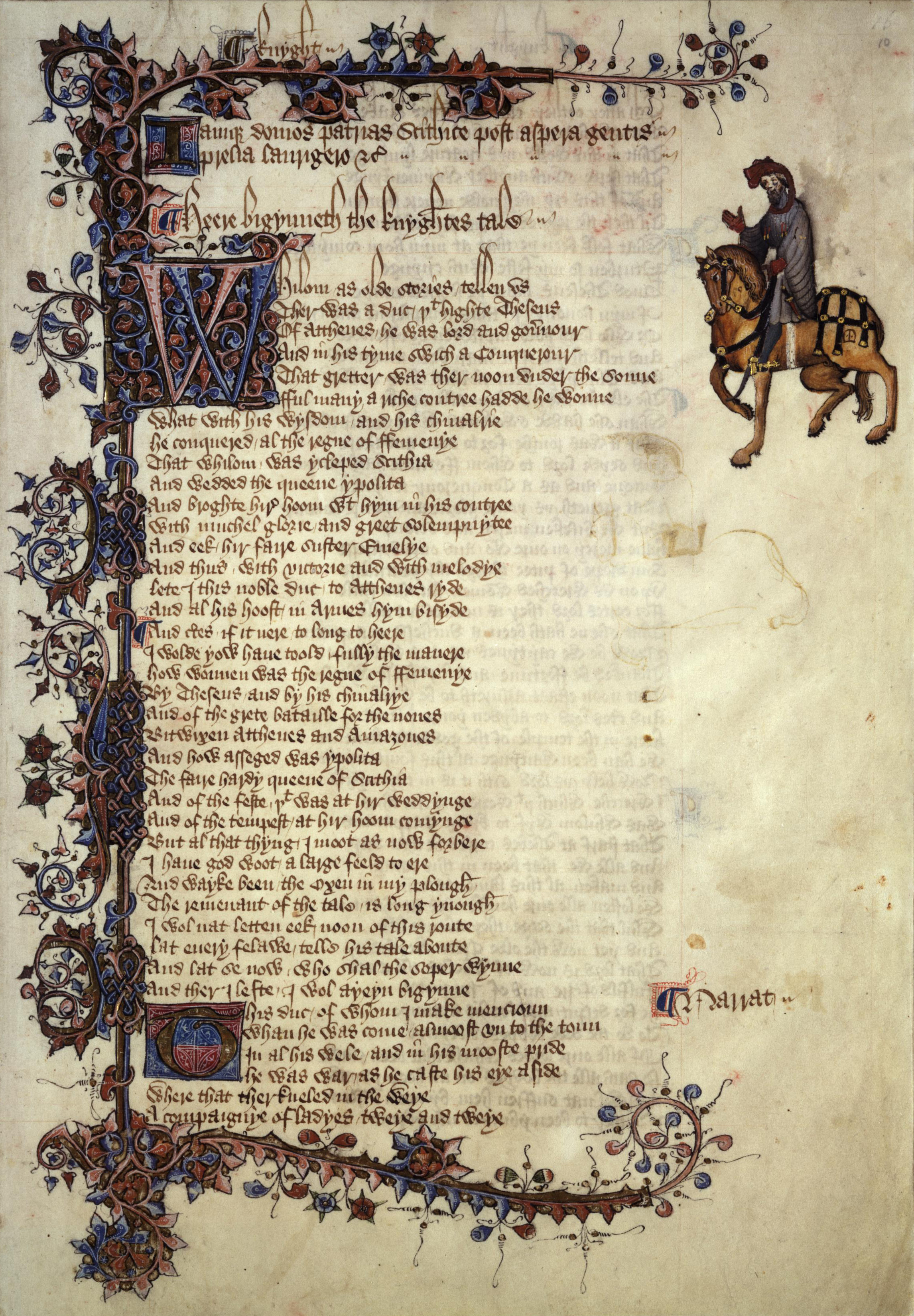
The book itself remains of great worth not only for its textual contribution but also for its outstanding workmanship. Fortunately, the original Ellesmere manuscript survives to this day largely undamaged, due to the fact that it has rested in libraries since around 1600. The manuscript is beautifully bound and printed on 232 pages of the finest quality thin vellum, sound and flexible. The page dimensions are noteworthy, nearly 16 x 11 inches. However, the main glory of the manuscript is the lavish illumination and illustration, in which the Ellesmere is easily unrivaled. On no less than seventy-one pages large foliated initials are joined to "demi-vinet" borders (conventionalized vines), in gold and other colors, framing the text on three sides. Opposite the first line of each tale is the figure of that tale’s narrator. There are twenty-three highly individualized portraits, including a very famous one of Chaucer himself. The miniatures are of great charm and interest and all show a perfect understanding of the text they are intended to illustrate, unusual for medieval illustrations. Studies of illumination indicate that the manuscript was probably the work of three to four craftsmen and, interestingly, not of monks. The evidence suggests that the text, border, and figures were all done at the same time, also unusual for medieval manuscripts.
 |
| The first page of the knight's tale. The demi-vinet and the knight's miniature are both visible. |
Thus the significance of the Ellesmere Chaucer is impressive: it is one of the two or three earliest manuscripts, one of the best authorities for the order of the tales, and one of the most splendid examples of medieval bookmaking. The Ellesmere Chaucer is easily the finest manuscript of The Canterbury Tales and is in every respect worthy of Chaucer himself.
 |
| A portrait of Chaucer. |